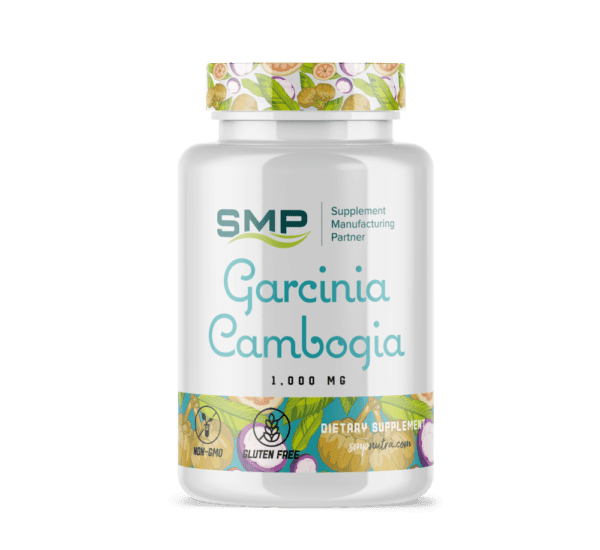
Garcinia Cambogia 1,000 mg – Capsules – Non-GMO – Gluten-Free
SMP Nutra’s Garcinia Cambogia 1,000mg Capsules feature Garcinia cambogia, a tropical fruit-derived botanical that has been extensively studied for its naturally occurring hydroxycitric acid (HCA). This single-ingredient capsule formulation provides private label supplement brands with a recognizable botanical for developing products within the herbal, wellness, and weight-management supplement categories. The stock formulation is listed as non-GMO, gluten-free, vegetarian, and vegan-friendly.
Garcinia cambogia has attracted scientific interest primarily because of HCA, a naturally occurring organic acid found in the fruit rind. Laboratory research has examined HCA's interaction with ATP-citrate lyase, an enzyme involved in lipid biosynthesis, which provides a biochemical basis for continued research into Garcinia cambogia and metabolic processes.
Product Features
- 1,000 mg Garcinia cambogia per serving
- Garcinia cambogia botanical formulation
- Naturally contains hydroxycitric acid (HCA)
- Convenient capsule dosage form
- Non-GMO
- Gluten-free
- Vegetarian
- Vegan-friendly
- Single-ingredient herbal supplement formulation
- Suitable for private label Garcinia cambogia supplement brands
- Ideal for herbal, wellness, botanical, and weight-management-focused product portfolios
- Stock formulation for brands seeking a ready-to-brand Garcinia cambogia supplement
- Suitable for product concepts targeting keywords such as Garcinia cambogia capsules, 1,000mg Garcinia cambogia, Garcinia cambogia supplement, HCA supplement, hydroxycitric acid capsules, botanical weight management supplements, and private label Garcinia capsules
Educational Information
Garcinia cambogia is a small tropical fruit-bearing tree found throughout parts of Asia, Africa, and Polynesia. The fruit's rind contains hydroxycitric acid, commonly abbreviated as HCA, which is considered the primary compound of scientific interest in Garcinia cambogia research.
One reason HCA has received attention is its relationship with cellular lipid metabolism. Laboratory research has investigated HCA's ability to inhibit ATP-citrate lyase, an enzyme involved in converting citrate into acetyl-CoA, a molecule used in several metabolic pathways.