
Common Mistakes New Supplement Brands Make Before Manufacturing
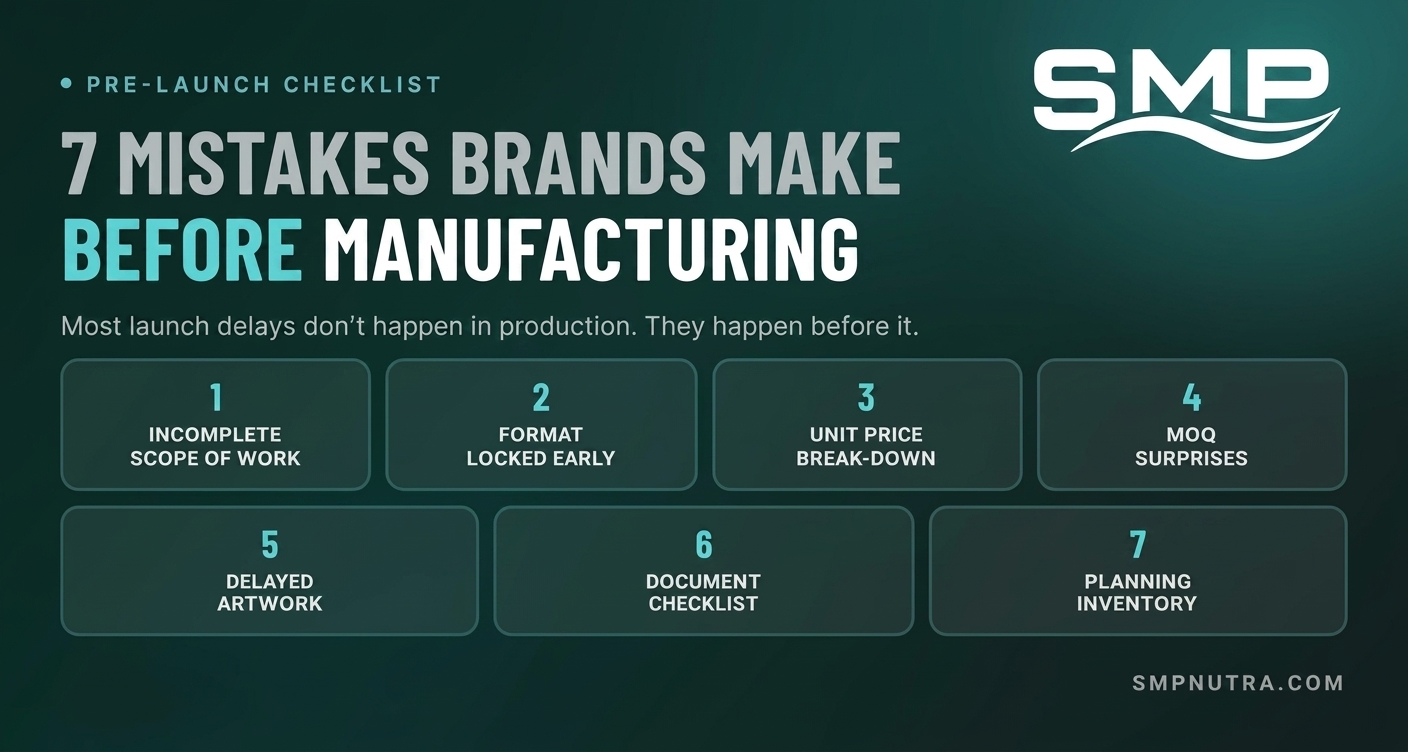
Many supplement launch problems begin before a purchase order is issued or production is scheduled. A new brand may request pricing before defining the formula, select packaging before confirming the product format, or set a launch date before understanding artwork and approval requirements.
These are normal first-project challenges. Supplement manufacturing involves connected decisions across formulation, production, packaging, testing, documentation, freight, and fulfillment. A change in one area can affect cost, minimum order quantity, lead time, or another part of the project.
Better preparation gives a manufacturer enough information to discuss realistic options and prepare a more useful quote. It also helps the brand compare manufacturers on the same scope instead of comparing numbers based on different assumptions.
Use this pre-manufacturing readiness checklist to identify missing decisions before requesting a quote, approving packaging, submitting artwork, or committing to a launch timeline.
What Mistakes Should Supplement Brands Avoid Before Manufacturing?
New supplement brands should avoid requesting quotes without enough project detail, choosing a format before reviewing its production requirements, and comparing manufacturers only by unit price. Other common mistakes include overlooking minimum order quantities, delaying packaging and artwork decisions, failing to discuss testing or documentation requirements, and planning the first order without considering reorders.
Most of these issues can be reduced by defining the product scope, narrowing the format and packaging direction, preparing clear questions, and discussing timeline expectations before production planning begins.
Mistake 1: Asking for a Quote Without Enough Project Details
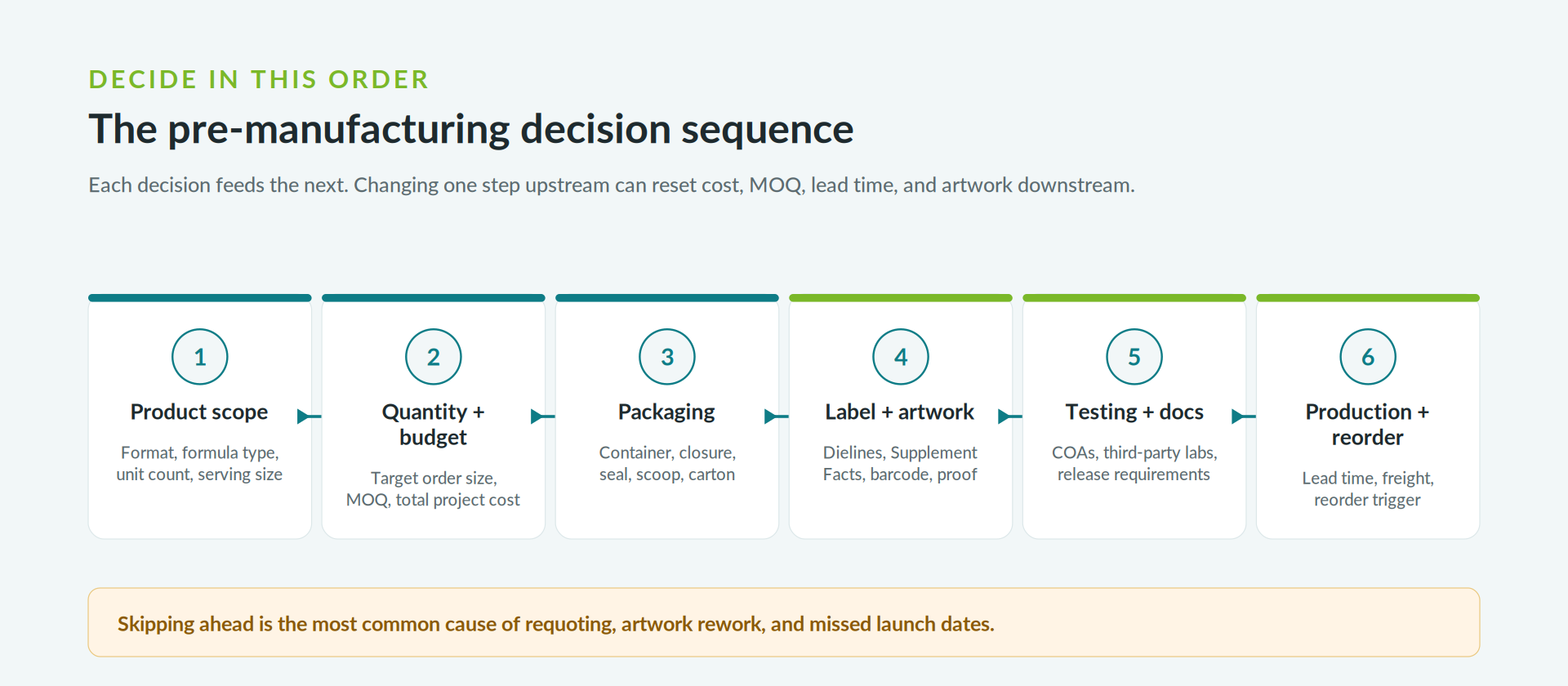
A request such as “How much does it cost to manufacture a supplement?” does not provide enough information for meaningful pricing. The cost of a supplement project depends on what is being produced, how much is being ordered, how it will be packaged, and much more.
A manufacturer will generally need to understand:
- The desired format, such as capsules, tablets, gummies, powders, softgels, or liquids
- Whether the project will use a stock or private label product, an existing formula, or a new custom formula
- The target order quantity
- The number of capsules, tablets, gummies, servings, or fluid ounces per unit
- The expected serving size or fill weight
- The preferred bottle, jar, pouch, stick pack, sachet, or other packaging
- Whether label artwork is complete, in development, or not yet started
- The expected sales channel, such as Amazon, direct-to-consumer ecommerce, retail, practitioners, or wholesale
- Any testing, documentation, shipping, or fulfillment requirements
- The target launch window
These details do not need to be final before the first conversation. However, the manufacturer should be told the answer to as many of those questions as possible; if you are unsure of some of those answers, they can help you come to a conclusion and pick the best options for your goals.
For example, a quote for 2,500 bottles of 60 capsules is materially different from a quote for 2,500 bottles of 120 capsules. A stock formula with a standard bottle may also follow a different pricing and scheduling path than a custom formula with specialty packaging.
Before contacting a manufacturer, organize the solidified details of your project in one clear and concise brief for the easiest communication and path forward when you do begin to communicate with a manufacturing facility.
Mistake 2: Choosing a Supplement Format Too Early
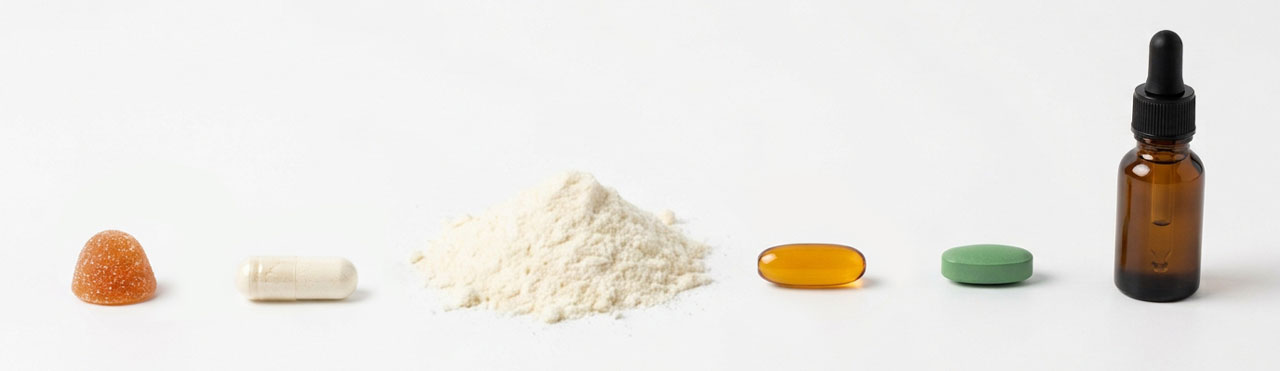
Founders often begin with a preferred format because it fits their brand concept or appears popular in the market. That preference is useful, but it should be tested against production requirements before the format is locked in.
The format can affect:
- Manufacturing complexity
- Minimum order quantity
- Ingredient and serving-size limitations
- Packaging options
- Flavor and texture development
- Tooling or setup requirements
- Lead time
- Shipping weight
- Storage and fulfillment
- Reorder economics
Gummies, for example, may involve flavor, texture, heat-processing, packaging, and MOQ considerations. Powders may require flavor development, blending, scooper size selection, fill-weight planning, and a decision between tubs, jars, pouches, or stick packs.
Tablets may involve compression, coating, tooling, and disintegration requirements. Softgels and liquids can require specialized production and packaging capabilities. Capsules may provide a practical route for many first products, depending on the formula, serving size, ingredient properties, and commercial goals.
The issue is not whether one format is better than another. The issue is whether the selected format fits the project’s budget, quantity, packaging plan, timeline, and fulfillment model.
A brand that initially wants a gummy may decide that a capsule or powder is a more workable first launch. Another brand may keep the gummy format but revise its budget, timeline, or order quantity after reviewing the requirements.
Mistake 3: Comparing Manufacturers Only by Unit Price
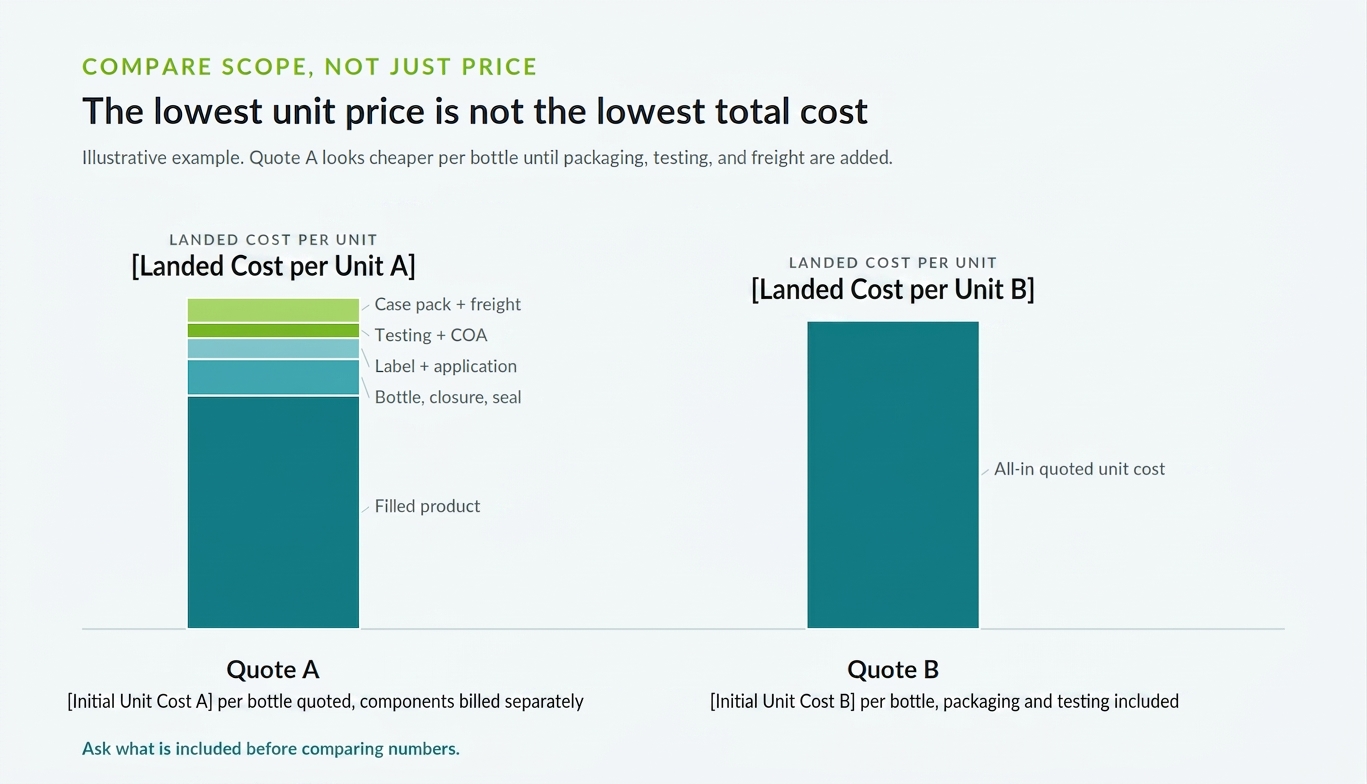
The lowest quoted cost per bottle, pouch, or unit is not automatically the lowest total project cost. Two manufacturers may be quoting different products, services, packaging components, testing requirements, or delivery terms.
One quote may include a bottle, closure, label application, induction seal, case packing, and release documentation. Another may show only the cost of the filled product, with packaging and related services listed separately.
Buyers should also consider the potential quality difference between a lower and higher unit price. Commonly, if the price is lower for the same exact project, the finished goods will be of lesser quality due to something along the process.
Communication should be part of the evaluation. A manufacturer should be able to explain what the quote covers, which decisions could change the price, and what must happen before a production timeline can be discussed.
Compare quotes on the same scope:
- Same formula or product specification
- Same unit count or fill weight
- Same order quantity
- Same packaging configuration
- Same testing and documentation requests
- Same freight or fulfillment handoff
- Same level of customization
Unit price still matters, but review it with MOQ, setup costs, packaging, lead time, payment requirements, and reorder economics.
Supplement Manufacturing Quote Comparison Table
| Quote area | Why it matters | Question to ask |
| Unit price | Shows the estimated per-unit cost, but may not show the full scope. | What assumptions and services are included in this price? |
| MOQ | Affects startup budget, inventory exposure, and per-unit economics. | What order quantity is this quote based on? |
| Packaging | Components can change both cost and lead time. | Are the bottle, closure, label, seal, carton, pouch, or scoop included? |
| Setup costs | Tooling, development, printing, or production setup may be separate. | Are there one-time or recurring setup charges? |
| Testing and documentation | Project-specific requests may affect cost and release timing. | What testing and documentation are included? |
| Lead time | Different scopes and approval stages can produce different schedules. | What must be completed before timing can be estimated? |
| Freight | Shipping terms affect the landed cost of the inventory. | Is freight included, estimated separately, or arranged by the buyer? |
| Fulfillment handoff | Case packing, palletization, labeling, or prep may add costs. | Is the order being prepared for a warehouse, retailer, Amazon, or another fulfillment partner? |
Mistake 4: Ignoring MOQ Before Budgeting
Minimum order quantity is not simply an arbitrary number selected by a manufacturer. It can reflect production setup, ingredient purchasing, packaging minimums, label-printing quantities, testing costs, equipment efficiency, and labor requirements.
A founder may budget for 500 finished units and later learn that the desired format, formula, or package requires a larger production run. This can affect cash flow, storage requirements, fulfillment costs, and the amount of inventory the brand must sell before reordering.
MOQ can vary based on:
- Stock or private label versus custom manufacturing
- Product format
- Formula complexity
- Unit count or fill weight
- Standard versus custom packaging
- Label and carton printing requirements
- Ingredient or component supplier minimums
- Production equipment and setup
Custom packaging can create a separate minimum even when the manufacturing MOQ is manageable. A bottle, closure, carton, scoop, pouch, or printed component may need to be ordered in quantities that do not match the first production run exactly.
Brands should discuss MOQ before finalizing the budget or designing the launch around a specific unit quantity. Review the MOQ for the finished product and the minimums attached to packaging, labels, ingredients, and other components.
Mistake 5: Waiting Too Long on Labels, Artwork, and Packaging Decisions
A formula may be ready while the project remains delayed by an undecided bottle, incomplete label file, missing barcode, or artwork that does not fit the final package.
Packaging and label work are connected. The bottle, jar, pouch, or other container usually needs to be selected before the final label dimensions and dieline can be confirmed. Changing the package late may require updated pricing, revised artwork, new print files, and another approval cycle.
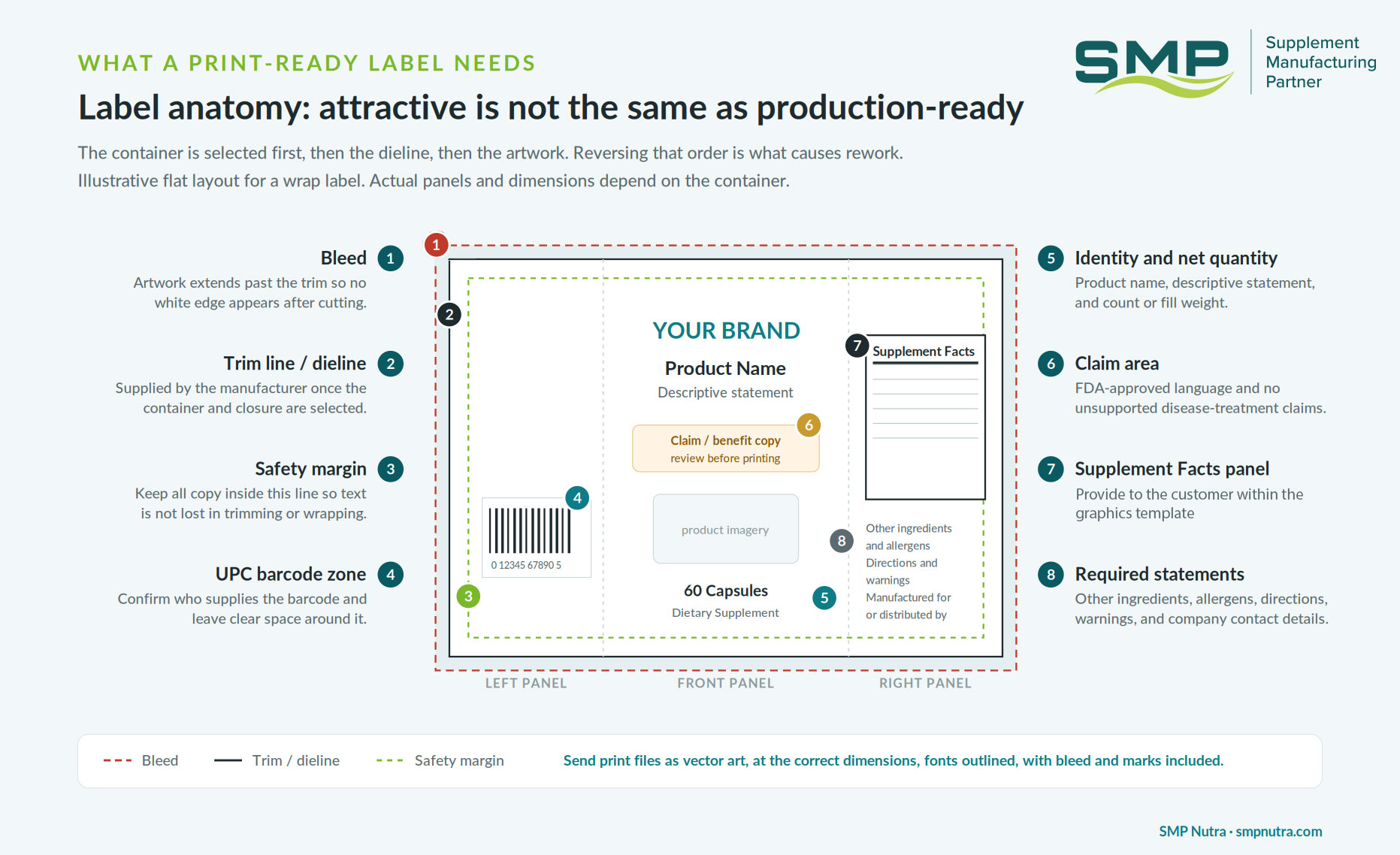
Brands should plan for the following items early:
- Container type and size
- Closure, liner, induction seal, scoop, or desiccant requirements
- Label dimensions or packaging dielines
- Supplement Facts panel
- Ingredient and allergen information
- Required statements and warnings
- Barcode placement and verification
- Brand claims and marketing copy review
- Print-ready artwork files
- Final artwork approval
- Ecommerce, Amazon, retail, and wholesale image requirements
A designer can create an attractive label that is not yet production-ready. The file may use the wrong dimensions, omit required information, contain an outdated Supplement Facts panel, or lack proper bleed and print settings.
Claims should also receive careful attention. Packaging language should not imply that a dietary supplement is FDA-approved or make unsupported disease-treatment claims.
Do not wait until the intended production date to begin label review. Confirm who is responsible for preparing the Supplement Facts information, reviewing the copy, supplying the barcode, and approving the final proof.
Mistake 6: Overlooking Testing, Documentation, and Quality Questions
Testing and documentation requests should be discussed during quoting, not added after production is already being planned.
The requirements can depend on the product, ingredients, format, sales channel, customer agreements, and the brand’s own quality procedures. Buyers should not assume that every quote includes the same tests or documents.
Questions may include:
- What certificate of analysis documentation is provided?
- Which tests are included in the quoted scope?
- Are third-party laboratory reports available or requested separately?
- Are identity, microbial, heavy metal, or other tests relevant to this project?
- What documentation is available for ingredients or finished products?
- What information will be needed before the order can be released?
- How could additional requests affect cost or timing?
Testing documentation supports manufacturing review and buyer due diligence. It does not prove health outcomes, guarantee product performance, or mean that the dietary supplement has received FDA approval.
A brand selling through a retailer, distributor, practitioner network, or online marketplace may also have documentation requirements outside the manufacturer’s standard package. These should be identified before production so the parties can determine what is available, what must be requested, and whether additional time is needed.
Mistake 7: Planning the First Order Without Planning the Reorder
The first production run receives most of the attention because it is tied to the launch. Reorder planning is often postponed until inventory is already running low.
That creates problems when the brand discovers that production, packaging procurement, label printing, approvals, freight, and warehouse receiving require more time than expected.
Before placing the first order, estimate:
- Expected monthly sales by channel
- Inventory reserved for samples, promotions, replacements, or wholesale
- Warehouse and fulfillment receiving time
- The manufacturer’s expected reorder lead time
- Packaging and label availability
- Cash needed for the next purchase order
- The inventory level that should trigger a reorder
Reorders may be more straightforward when the formula, quantity, package, label, and specifications remain unchanged. A new flavor, revised serving size, different bottle, updated label, or new testing request can add development and approval steps.
A brand does not need a perfect demand forecast. It does need a working inventory assumption and a reorder trigger. For example, waiting until only two weeks of stock remain is unlikely to leave enough time for many manufacturing projects.
Discuss lead-time factors before the launch, then review sales velocity regularly after inventory becomes available.
Pre-Manufacturing Readiness Checklist
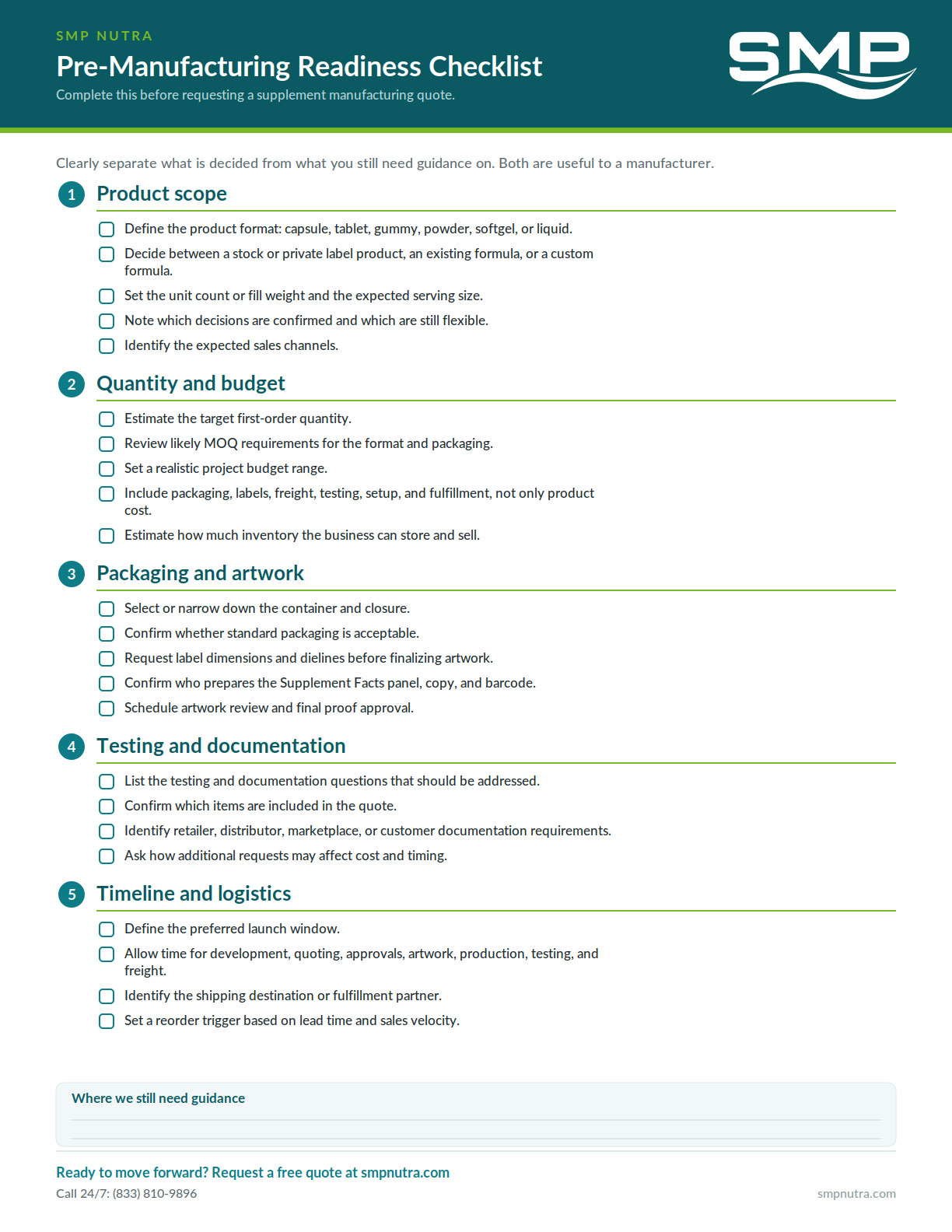 Pre-Manufacturing Readiness Checklist.pdf
Use this checklist before contacting SMP Nutra or another supplement manufacturer.
Product Scope
- Select or narrow down the desired format.
- Define whether the project will use a stock product, an existing formula, or a custom formula.
- Identify the target serving size, fill weight, and unit count.
- Note which product decisions are final and which remain flexible.
- Identify the expected sales channels.
Quantity and Budget
- Estimate the target first-order quantity.
- Review likely MOQ requirements.
- Set a realistic project budget range.
- Consider packaging, labels, freight, testing, setup, and fulfillment costs in addition to the product cost.
- Estimate the amount of inventory the business can store and sell.
Packaging and Artwork
- Select or narrow down the container and closure.
- Confirm whether standard packaging is acceptable.
- Identify the current status of label design and artwork.
- Confirm responsibility for the Supplement Facts panel, barcode, warnings, and final copy.
- Check whether cartons, scoops, seals, inserts, or custom components are needed.
- Identify marketplace, retail, or fulfillment labeling requirements.
Testing and Documentation
- List the testing and documentation questions that should be addressed.
- Confirm which items are included in the quote.
- Identify any retailer, distributor, marketplace, or customer documentation requirements.
- Ask how additional requests may affect cost and timing.
Timeline and Logistics
- Define the preferred launch window.
- Allow time for development, quoting, approvals, artwork, production, testing, and freight.
- Identify the shipping destination or fulfillment partner.
- Confirm any Amazon, retail, or warehouse preparation requirements.
- Establish an initial reorder trigger and cash-flow plan.
How to Avoid These Mistakes Before Requesting a Quote
Start with scope clarity rather than price. Write down the format, product direction, quantity, unit count, packaging preference, label status, sales channel, and desired timeline.
Next, identify where you need guidance. A brand may know that it wants a powder but remain open to a tub or pouch. Another may have a capsule formula but need help understanding the practical difference between 60-count and 120-count packaging.
Ask how the preferred format affects MOQ, packaging, lead time, and fulfillment. Confirm what is included in each quote and request clarification on any exclusions or assumptions.
Prepare packaging and label questions early. Do not assume final artwork can be completed before the package dimensions and required information are confirmed.
Discuss testing and documentation requirements before production planning. Requirements added later may affect the scope or schedule.
Finally, think beyond launch day. Estimate how quickly inventory may sell, when the next order should be placed, and whether packaging or label components could limit reorder timing.
Clear preparation does not make every project simple, but it gives the manufacturer and brand a better basis for discussing options, pricing, responsibilities, and next steps.
Frequently Asked Questions
What should I prepare before contacting a supplement manufacturer?
Prepare the desired format, formula direction, target quantity, unit count or fill weight, packaging preference, label status, sales channel, timeline, shipping destination, and any testing or documentation questions. Clearly separate confirmed decisions from areas where you need guidance.
Is choosing the lowest supplement manufacturing price a mistake?
Not necessarily, but price should be compared on an equivalent scope. Review the formula, unit count, MOQ, packaging, testing, documentation, setup costs, freight, and fulfillment services behind each number. A lower unit price may be based on a larger order quantity or fewer included services.
Can label files delay supplement manufacturing?
Yes. Incorrect dimensions, unfinished artwork, missing information, unresolved claims, barcode issues, or a change in packaging can delay printing and packaging preparation. Confirm the container and label specifications before submitting final artwork.
Why does MOQ matter before budgeting?
MOQ affects the amount of inventory the brand must purchase and finance. It may also affect storage, fulfillment, cash flow, and reorder planning. Manufacturing, ingredients, labels, and custom packaging can each have separate minimums.
Should I choose a supplement format before getting a quote?
Narrowing the format is helpful, but remain open to discussing alternatives. The chosen format can affect MOQ, production complexity, packaging, serving size, lead time, and cost. A manufacturer may need formula and quantity details before confirming whether the preferred format is practical.
What testing or documentation questions should I ask early?
Ask which tests and documents are included, what certificate of analysis information is provided, whether third-party testing requests are available, and whether project-specific identity, microbial, heavy metal, or other testing is relevant. Also identify any documentation required by retailers, distributors, marketplaces, or business customers.
How early should a supplement brand plan reorders?
Reorder planning should begin before the first production run. Estimate sales velocity, production lead time, packaging availability, freight, warehouse receiving, and cash requirements. Set a reorder trigger that leaves enough inventory to cover the expected replenishment period.
Share Your Manufacturing Project Requirements with SMP Nutra
If you have collected all the information you need to begin getting a quote on your project, reach out to SMP Nutra today with that info so we can see how we can assist you in bringing your vision to life.
The team at SMP Nutra is equipped with a world-class team and facilities to support nearly any nutraceutical manufacturing project and has the expertise to help you along the way with any questions or concerns you may have.
Manufacturing Price Quote
Fill out the form below and our team will get back to you with a custom quote for your supplement manufacturing needs.